
One of the oldest fragments of the Torah (Deuteronomy 26, 5-9), sums up how the Jewish people saw itself, and it is significant both for what it is said and what it is not said:
"My father was a wandering Aramean who went down to Egypt and lived there as an immigrant with few people that came. There he became a great nation, strong and numerous. The Egyptians mistreated us, oppressed us and imposed heavy work on us. Then we implored the help of the Lord God of our fathers, and he heard our cry and saw our misery, our pains and our oppression. The Lord brought us out of Egypt with a strong hand and powerful arm, amid breathtaking feats, with signs and wonders; let us in this place and gave us this country, a land flowing with milk and honey."
The
Jewish people is considered descendant of the patriarch Abraham, which means
from nomadic tribes that around 1900 BC moved westward from Ur, in Mesopotamia,
in search of a place to settle. They settled in the land of Canaan, around the Jordan
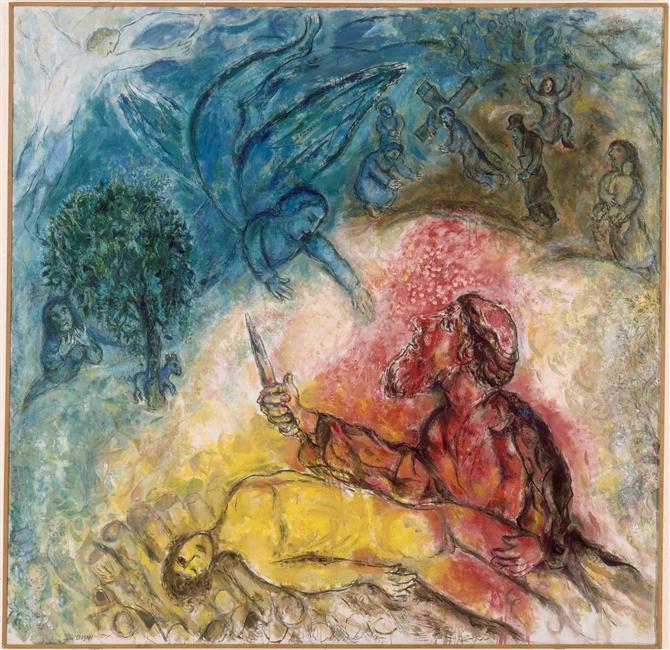
River. When he was already quite old, Abraham had a son, Isaac, by his wife
Sarah, and his faith in God was so strong that he accepted to offer this only
son as a sacrifice; God, however, seeing his faith, released the commandment.

Isaac had two sons, Jacob and Esau; Jacob was the youngest, but bought the birthright for a lentil dish one day that Esau was hungry (all these stories should be interpreted symbolically; in this case, it may indicate that whoever gives priority to materiality, food, loses the favor of the Lord). Jacob is also often called "Israel," and seems to be the initiator of the "real" history of the Jewish people; Abraham would be a sort of prologue included later to link Israel with Mesopotamian precedents. Likewise, Abraham is an "ideal" figure (obedient to God, devoutly faithful and morally complete), while Jacob is "real" (intriguing, clever, cunning...).
Isaac had two sons, Jacob and Esau; Jacob was the youngest, but bought the birthright for a lentil dish one day that Esau was hungry (all these stories should be interpreted symbolically; in this case, it may indicate that whoever gives priority to materiality, food, loses the favor of the Lord). Jacob is also often called "Israel," and seems to be the initiator of the "real" history of the Jewish people; Abraham would be a sort of prologue included later to link Israel with Mesopotamian precedents. Likewise, Abraham is an "ideal" figure (obedient to God, devoutly faithful and morally complete), while Jacob is "real" (intriguing, clever, cunning...).
Jacob had twelve sons, who originated the
twelve tribes of Israel (twelve is the last of the numbers with strong symbolic
meaning, representing the whole, the totality, the harmonious and well
structured. Thus the twelve months of the year, the zodiac signs, the tribes of
Israel, the disciples of Jesus...). One of these twelve tribes was the powerful
tribe of Judah; from this term derive “Judaism” and “Jew”.
One of the twelve sons of Jacob, Joseph,
moved to Egypt around 1700 BC; since there was work there and there were
droughts in Canaan, he called the Jewish people. But in later generations the
Pharaohs began to oppress the Jewish people, which decided to fight for its
freedom and return to the land of Canaan, the Promised Land, in 1270 BC. The
leader of this struggle and consolidator of Jewish religious identity, Moses,
was apparently raised by the Egyptians, but recovered and deepened the faith of
his ancestors and led the Jews out of Egypt during the reign of pharaoh Ramses
II. This entailed intense experiences as the passage of the Red Sea or the
experience of revelation of Yahweh at Mount Sinai (although there is a
hypothesis that this revelation comes from a group of tribes who had not been
in Egypt and joined the ones that had done the exodus in order to conquer
Canaan. These tribes had its own tradition of having had an experience of the
divine in a sacred mountain, of which they derived the pact of alliance with
God and the reception of the divine law. Then the two traditions would have merged
in one, personalized by Moses, who must have been an exceptional person: tribal
chief, military leader, priest, inspired seer, prophet and legislator).
Yahweh is not really the name of God. In
Hebrew, God is Elohim; he is also
called “the Lord”, Adonai. Yahweh is
an indication of the fact that God has no name, is unnamable, ineffable. In
Exodus 3, 14 Moses asks God about his name, and God says “I am who I am. You will say to the Israelites: I am sent by I am”. A brilliant way to represent this
lack of name was to designate the divinity with four unpronounceable letters (iod, he,
vav and another he, written from right to left), that seem to invocate an
inspiration and an expiration with the two corresponding posterior pauses.

The Sinai revelation was summarized in the Tables of the Law, containing the Ten Commandments. They were placed in a wood box covered with gold, with two angels on it. This was the Ark of the Covenant. When the Jewish people camped, the Ark was placed under a large tent which was also a meeting place, the Tent of the Gathering. These are the Ten Commandments (Exodus 20, 1-17 and Deuteronomy 5, 6-21):
“God said to the people of Israel:
I am the Lord your God, the one who brought you out of Egypt where you were slaves.
1.- Do not worship any god except me. Do not make idols that look like anything in the sky or on earth or in the ocean under the earth. Don't bow down and worship idols. I am the Lord your God, and I demand all your love. If you reject me, I will punish your families for three or four generations. But if you love me and obey my laws, I will be kind to your families for thousands of generations.
2.- Do not misuse my name. I am the Lord your God, and I will punish anyone who misuses my name.
3.- Remember that the Sabbath Day belongs to me. You have six days when you can do your work, but the seventh day of each week belongs to me, your God. No one is to work on that day—not you, your children, your slaves, your animals, or the foreigners who live in your towns. In six days I made the sky, the earth, the oceans, and everything in them, but on the seventh day I rested. That's why I made the Sabbath a special day that belongs to me.
4.- Respect your father and your mother, and you will live a long time in the land I am giving you.
5.- Do not murder.
6.- Be faithful in marriage.
7.- Do not steal.
8.- Do not tell lies about others.
9.- Do not want anyone’s wife or husband.
10.- Do not want anything that belongs to someone else. Don't want anyone's house, field, slaves, oxen, donkeys or anything else.”

Moses is attributed the authorship of the five books of the Torah: Genesis, that Jews call Bereshit (which is the first word of the book: “in the beginning”), explaining the creation of the world and humanity, with Adam and Eve expelled from Paradise, the fight between their sons Cain and Abel, the Universal Flood and Noah's Ark, the Tower of Babel and the story of Abraham, Isaac, Jacob and Joseph; Exodus, which describes the escape from Egypt and the Covenant with Yahweh; Leviticus, dedicated to the establishment of codes and rituals; Numbers, which reflects the experience of the way from Sinai to the plains of Moab, and Deuteronomy (Deborim in Hebrew), which includes Moses’ final speeches and his death. It is considered that the first eleven chapters of Genesis gather Mesopotamian and Egyptian mythologies, adapted by later Hebrew thought. The second part of the Jewish Holy Scriptures is called Nebim (“prophets”) and the third one Ketubim (“writings”). The initials of the three parts are TNK, pronounced TaNaK, embracing all of the Jewish scripture, which will be assumed and called “Old Testament” by the Christian tradition.
The
first period after Moses death, described in books like Joshua, Judges, Ruth,
Samuel and Kings, includes the experience of the conquest of Canaan in battle
with neighboring tribes, a time ruled by the so called “judges” (liberators,
charismatic leaders, as was also Deborah; they are exalted by Yahweh and his
spirit descends upon them). The main judges are Joshua (successor of Moses and
conqueror of Canaan to the Amorites), Gideon, Samson, and Samuel (seer, priest
and judge). It is a theocratic stage, the axes of which are worship, law and
charisma. Politically, Israel is a kind of confederation of tribes. Agriculture
gradually takes more weight in Jewish life and this is reflected in its
religious evolution, in detriment of mosaic prophethood.
The
following period sees the unification of the tribes and the controversial
instauration of the monarchy (Gideon had refused to take this step, even though
having been asked to do so), under pressure from the Philistine invasion
(people displaced from their land by the Greek invasion of the Peloponnese). It
will be the cycle that begins with Saul, a charismatic military leader who
becomes an autocrat (but not yet assuming religious authority).
The
second step of this monarchic cycle is King David (reign 1010-970 BC),
a complex and contradictory personality mixing successes and virtues with big
mistakes and regrets: military leader, he conquers Jerusalem to the Jebusites.
Jerusalem was a Canaanite sanctuary where a god called El-Elyon, Sedek and Shalem
was worshiped. David turned it into the capital of the kingdom and the center
of the worship of Yahweh, moving there the Ark of the Covenant –he himself made
a ritual dance in this procession- and beginning the construction of a new
temple. He successfully faced the Philistines, and he was polygamous: Abigail,
Aljinoam, Micol...


The third step is King Solomon (reign 970-931 BC). Also polygamous, he is famous for the wisdom attributed to him. He finishes the construction of the temple of Jerusalem and consolidates a centralized and autocratic monarchy in the Egyptian style, with a rich court sitting on oppressed people. He introduces in Jerusalem Egyptian, Moabite, Ammonite, Phoenician and Hittite worships, which join the Canaanite worships that had been maintained, while far from the court survived the traditional Yahwist worship. The tension between the prophetic Yahwism and the influence of Babylonian and Egyptian systems can be seen in the words of prophet Nathan to King David (1Cr 17, 4 -6): “Go and tell David my servant: the Lord says, “You shall not build me a house to dwell in; for I have not lived in a house since the day that I brought up Israel to this day, but have gone from tent to tent, and from one tent to another. In all places in which I have walked with all Israel, did I speak a word with any of the judges of Israel, whom I commanded to be shepherd of my people, saying, ‘Why have you not built me a house of cedar?”.

Prophets (“those who speak in the name of God”) are another major Jewish contribution to universal religiosity. Initially, it was apparently a group phenomenon (First Book of Samuel 1 to 10), with a more ecstatic than ethical character. Then came the individual prophets of oral tradition (Elijah, Elisha, Natan and Ajiyya), in which ecstasies and ethics mixed; their words were swift and powerful, and they received the visit of God when they were alone; they asked for justice in the name of God, and addressed themselves mainly to individual unfair behavior. The third group is that of the great prophets of written tradition (among which Amos, Hosea, Joel, Micah, Isaiah, Jeremiah, Ezekiel, Daniel, Malachi). They included in their claims those wrongs deriving from the social structure itself, from the corruption of the social order and from oppressing institutions. Prophets considered that social justice is a pre-requisite for political stability; that injustice cannot prevail, since God’s standards are high: he will not tolerate forever exploitation, corruption and mediocrity. Prophets were convinced that all human beings have rights that even kings must respect. They were a strange, explosive force, and have become a reference until our times.

On a historical level, it seems that Elijah and Elisha belong to the ninth century BC; Amos, Hosea and Jonah to the eighth century BC; Micah, Isaiah and Joel to the seventh century BC; and Jeremiah, Ezekiel and Daniel to the sixth century BC, the time of the deportation to Babylon and the subsequent Iranian influence. Malachi lives after the return from Babylon, and he is the last of the great prophets of Israel. The prophets opposed the degradation of worship and morals, as well as corruption; advocated a return to the original roots of Judaism (the time of Moses) and defended a more just social order. This was done in tension with the despotic monarchy, which often had syncretism trends at the religious level and that, by fastening the peasantry through taxes, exacerbated the polarization between rich and poor, between the urban glitz and rural depression. The message of the prophets was boosted by the conquest of the northern part of Israel by the Assyrian Empire in 721 BC and the later conquest of the southern part by the Babylonian Empire, which implied the deportation of the Jews to Babylon in 587 BC. Prophets, and not only those of Israel, aim at their peers proclaiming, in a rather compulsive way, the notion of a powerful being superior to them, that impels them to share their vision with other humans even at times when the safest or easiest or most logical thing to do would be to remain silent.
The TaNaK
combines the political history of Israel with its religious development,
brilliantly captured in the book of Psalms, the Wisdom books (full of wisdom,
including the book of Job, Proverbs, Cohelet or Ecclesiastes, Wisdom and Sirach
or Ecclesiasticus) and the lyrical poems of the Song of Songs, attributed to
Solomon.

From everywhere emerges its strict monotheism (if God is the one to whom life is delivered without reserves, to have more than one God would lead to divided loyalties...): “Listen, Israel, the Lord, our God, is only one” (Deuteronomy 6, 4), as well as the vision of this God as personal (meaning that, in the last resort, ultimate reality resembles more to a person than to a thing, resembles more to a mind than to a machine; he is an “Other”). The God of Israel is not prosaic (he is a Being of appalling majesty), is not chaotic (he melts in a divine unity), is not amoral or indifferent (he is a God of justice and love). The people of Israel have a great esteem for their notion of God, for “their” God.
For Jews, the fruit of this creator God, the
world, is very good, has an unquestionable value, as the initial fragment of
the Torah insistently proclaims, when describing the creation of the world (Genesis
1). This includes humans, which even in their fragility (“they are like grass”,
Salm 90, 6; “they are mud”, Salm 103, 14; “they are as easy to destroy as a
night butterfly”, Job 4, 19) and in their capacity to be evil (to be “sinners”,
Salm 51, 5, which means capable of “not attaining the goal”), they are of an
unnamable grandiosity (image of God), dotted with freedom and children of God. As
Huston Smith says, with these traits the human condition is drawn to avoid
several equivoques: romanticism (prevented by fragility), aspiration reductionism
(prevented by grandiosity), sentimentalism (prevented by sin), irresponsibility
(prevented by liberty) and a vision of life as something drifting in a cold and
indifferent sea (prevented by divine paternity).
Another fundamental trait of Judaism is
the value given to history: history is of primordial importance, and has a
sense. This is the ground for some specific attitudes towards social order and
collective life: it is worth to actively be concerned by social, political and
cultural issues of life. We are not “beyond circumstances”, we are “within the
circumstances”; the context in which life is experienced is relevant. And we must
take interest and feel responsible for the problems concerning societies and
cultures. We cannot be indifferent to the social domain. From which also the relevance
of collective action, of taking cooperative initiatives in order to change
things (to plan, to organize, to act together). The experience of the exodus
from Egypt structures the Jewish mentality, which saw in that foundational
liberating moment the manifestation of the power and the goodness of God and of
his interest in history. It is important to be attentive in order to find the
most favorable moments, the decisive opportunities. The world can be changed, and
to do it the accent has to be put in what should be, instead of putting it in
what it is. Progress is possible, living conditions can be improved.
After
Salomon’s death, Israel was divided in two kingdoms. The northern one fell
under the Assyrian domination in 721 BC and disappeared (“the Ten Lost Tribes
of Israel”). The southern one, the kingdom of Judah, was conquered by the
Babylonian empire of Nebuchadnezzar in 587 BC, with the consequent destruction
of the Temple of Jerusalem and the deportation of the Jews to Babylon. In the
Babylon exile is where the Torah starts to be transferred from oral tradition
to scripture, so that it would not be lost nor forgotten; these Scriptures
became the most important shared reference of Judaism. In 539 BC, however,
Persian king Cyrus defeats the Babylonians and allows the Jews to return to
Jerusalem, where they rebuild the Temple. The Persian domination lasts until
333 BC, with the invasion by the Macedonian troops of Alexander the Great. In
63 BC the Romans of Pompeius become - partly at the request of the Sadducees
themselves - the new dominators of the territory, which they will call
Palestine. Judea becomes a Roman province, ruled by local kings appointed by
Rome (as Herod the Great) and later by procurers.
It is
during this long period of occupations that historical Judaism is structured
(Scripture, Sabbath, Synagogue). Important Jewish communities were established
outside of Israel, mainly in Babylon and Egypt. Priests took more significance,
and along with the role of priests, in this period scholars are also important,
producing the Jewish wisdom literature. Since the Persians treated the Jews
better than the Babylonians, Persian thought exerted more influence in Judaism
(resurrection of the body, the final judgment, final transformation of the
earth, more relevance of dualism...). Even before the exile, Jews took into consideration a
capital problem (also considered by the Persians, originally monotheistic): The
universe can be conceived as the creation of a higher being, omnipotent, by
whose empire it exists and that is continuously involved in the evolution of
things. But if the notion of moral virtue is applied to this being, how can the
apparent injustices of life, the pain mankind suffers, be explained? A
significant response is that of the Book of Job ("it cannot be understood,
but this does not suppress the existential experience of the sacred"). Another
response is Persian dualism: evil cannot come from God but from another
principle, a hostile spiritual power (the devil, Satan, Lucifer).
The opposition
of the Jews to Hellenization is reflected by the Book of Daniel (II century
BC). It received the support of the Pharisees (the "separated", a
pious and progressive sect; they were patient and sincere, ascetic and
interested in people’s lives) and was opposed by the Sadducees, conservative
and closer to the more conventional Sirach. At this time the Hasmonean family
(with Judah Maccabee in front, who died in 160 BC) led a revolt in the form of
guerrilla warfare against the Seleucid Empire of Antiochus Epiphanes, in which
converged both the pious and pro-independence sectors. Once the Greek
persecution was finished, the Sadducees occupied the political power, to which
they later also associated the Pharisees. Other sects appeared, as the Essenes
(devout and nonconformist) and the Zealots (political activists in the
tradition of the Maccabees). In the first century BC a significant role is
given to the apocalyptic literature, of a rather dualistic, messianic and
eschatological orientation (Persian influence).
The Romans will have to face the Jewish
revolt of 66 AD, deriving from the attempt of procurer Gesius Florius to take a
good part of the Temple’s treasure. Romans will have to leave Jerusalem, but
three years later the troops of general Titus conquer the city again, which
will lead to a new destruction of the Temple in 70 AD and to the tragic
suppression of the last focus of resistance in the fortress of Massada in 74 AD.
In 132 AD, the Jews rebelled again against Hadrian: in 135 AD, Hadrian's army
defeated the Jewish armies and Jewish independence was lost. Jerusalem was
turned into a pagan city called Aelia Capitolina and the Jews were forbidden to
live there, and Hadrian changed the country's name from Judea to Syria
Palaestina. This lead to exile thousands of Jewish families: to Egypt,
North-Africa, the Iberian Peninsula (which they will call Sepharad, and from where
they will be ousted in 1492), Europe (in 1290 they will be driven out from
England), India, China... This was a high point in the process of the Diaspora ("dispersion"): although
since centuries before the Jews were scattered across different territories,
from 135 AD on they are essentially a dispersed people. The sacrifices in the
Temple will cease to be the central reference, being replaced by the study of
the Torah and the oral tradition in academies and synagogues. Priests have no
longer a significant role, being replaced by rabbis (“teachers”), which devote all their lives to the study of
the Torah and to keep Judaism alive. Mind acquires a leading role in religious
life, and mental energies are oriented towards devotion. To study and interpret
the scriptures becomes a way of worship. On these grounds, Judaism survived in
history.

After the writing of the TaNaK, the meditation of so many rabbis on the Bible itself and on the experience of their people was gathered in the Mishnah, to which still many more comments were added, which lead to gather it all, around 500 AD, in the Talmud, a consultation work that was key in the maintenance of Jewish identity. How the Jewish people survived a thousand years of dispersion and reappeared with vigor in the Middle Ages is exceptional. Maimonides (1135-1204) is a figure of great intellectual stature, who attempts to reconcile the human rational and empirical knowledge with faith in the omnipotent deity; philosopher, mathematician and physicist, he thought a lot on how to adapt the old scriptures to new times. At the same time it seems that in Germany flourished more emotional currents of Judaism, focused on love and feelings (as simultaneously happened in Christianity with St. Francis of Assisi, in Italy, and later also in Germany with the "modern devotion").
In
parallel we find the mystical tradition of the Kabbalah ("tradition"), which seems to come from Iraq,
from where it would have spread to Italy in the ninth century and to Germany in
the tenth century. From Iraq it would have also reached Provence in the twelfth
century (where the Languedocian Isaac the Blind was active), scattering via
Girona into Spain, where it was prominent in the fourteenth century (and where
shines the Zohar, the “book of the
splendor”, a mystical text of about 1300, the main author of which is Moses Shem
Tov (1240-1305), who operated in León). Girona was the capital of Catalan
Judaism, and there taught Rabbi Acher ben David, a disciple of Isaac the Blind.
Rabbi Azriel seems to have first explicitly formulated there the fundamental
principles of cabbalism, which includes the theory of numbers (sefirot, in singular sephira) as mediators between the
ineffable Ein Sof and the cosmos, as well as the symbolic reading of biblical
texts.
The
aforementioned emotional currents were initiators or precedents of the great
emergence of Hasidism (Hasid means “pious”), which took place
in Poland in the eighteenth century following Israel ben Eliezer (1700-1760),
the "master of the good name", also known as “Baal Shem Tov” and the
"Besht". He and his followers promoted a movement with thousands of
followers in Eastern Europe that for one hundred and fifty years impregnated
Jewish communities with a very humble and friendly character, where compassion
and brotherhood coexisted harmoniously with the joy of living and mystical
experiences. Hasidism is one of the most attractive faces of Judaism, and its
stories have universal value. In these, magical elements occur naturally, mixed
with moral considerations and advice about everyday behavior. These charming
tales easily suggest a link, because of their style and orientation, with the
traditional stories about a peculiar popular character, sometimes naive, other
times rogue and other times wise that appears in the tradition of the Middle
East with the name Nasruddin, also traceable in areas of Islamic influence in
China under the name Afanti.
An interesting religious byproduct of the
French Revolution of 1789 was the recognition of equal rights for Jews in 1791 by
the French National Assembly. In England this equality was not recognized until
1866. Moses Mendelssohn, with his translation of the Jewish Bible into German,
prepared the process of approximation of the Jewish community to German
culture and to contemporary scientific thought, which brought with it a
profound renewal movement of Judaism. In England and the United States there
were also reformist movements of Judaism, and, as usual, counter-movements
claiming the purity of tradition also appeared, as well as other centrist
movements who stayed halfway. This has led to four main currents within
Judaism: the ultra-orthodox, maintaining the way of life of the eighteenth
century Eastern Europe, the orthodox, trying to stay as close as possible to
tradition; the conservatives, which accept gradual changes and the progressive,
reformed or liberal current, favorable to renewal. This last group underlines
the purpose behind the norms more than its literality; in their communities
women can be rabbi and in their Synagogues men and women are not separated.
In fact, in the nineteenth and twentieth
century we simultaneously see in Europe places where Jews can reach normal
citizenship and places, such as Tsarist Russia, where they are severely
repressed, causing on one hand a large Russian Jewish migration to the United
States and on the other hand the appearance of the Zionist claim (Leon Pinsker,
1884). In 1896 Theodor Herzl publishes the book "The Jewish State".
Zionism will culminate in 1948 with the proclamation of the state of Israel. In
between, there is the terrible experience of the Shoah (literally "calamity", "destruction"),
the "holocaust" (“sacrifice consumed by fire”) that led to the
annihilation of six million European Jews by the Nazis. It started in 1933 and
was accentuated during World War II, reaching its peak between 1942 and 1945
with the "Final Solution" (the extermination of Jews in concentration
camps: Auschwitz-Birkenau, Chelmno, Belzec, Majdanek,
Mauthausen, Sobibor and Treblinka).


